Could a Sperm Whale Swallow a Person? The Anatomy and Odds
Most whales can’t swallow a person. A sperm whale might manage it anatomically, but the encounter and survival scenario described are extraordinarily unlikely.
The idea of being swallowed by a whale makes for a gripping thriller, but the biology sets strict limits on what could happen. Baleen whales can’t swallow a person at all. A sperm whale might be able to, in theory, yet the source’s experts describe the circumstances as so unlikely that the scenario is close to inconceivable—and the initial force could be fatal.
That distinction is central to Whalefall, a film premiering October 16, 2026. Based on Daniel Kraus’s 2023 thriller, it follows a diver looking for his late father’s remains who is swallowed by a sperm whale. With an hour of oxygen left, he tries to escape. The premise turns on a real difference between whale groups: what they eat, and the shape and stretch of their throats.
Why baleen whales can’t swallow a person
About 90 whale species are known to science, divided into two broad groups: toothed whales, including sperm whales, and baleen whales, including humpbacks and blue whales. Baleen whales feed by taking in water and filtering out small prey such as krill and plankton through rows of bristles. Their feeding method doesn’t require a wide passage into the esophagus.
That passage is roughly the size of a grapefruit, according to National Geographic. A person may end up briefly inside or near a humpback’s mouth during a feeding encounter, but that doesn’t mean the whale can swallow them. Accounts such as this reported incident involving a lobster diver describe people being released within seconds. A whale’s mouth can be enormous while the opening to its digestive tract remains too small for a human body to pass through.
This is a useful reminder that an animal’s overall size doesn’t tell the whole story. Feeding anatomy matters. Baleen whales take in large volumes of water to strain out tiny food, while toothed whales hunt larger prey such as fish, sharks and squid. Their gullets are larger, but that still doesn’t make a person a plausible meal for most of them.
The sperm whale exception
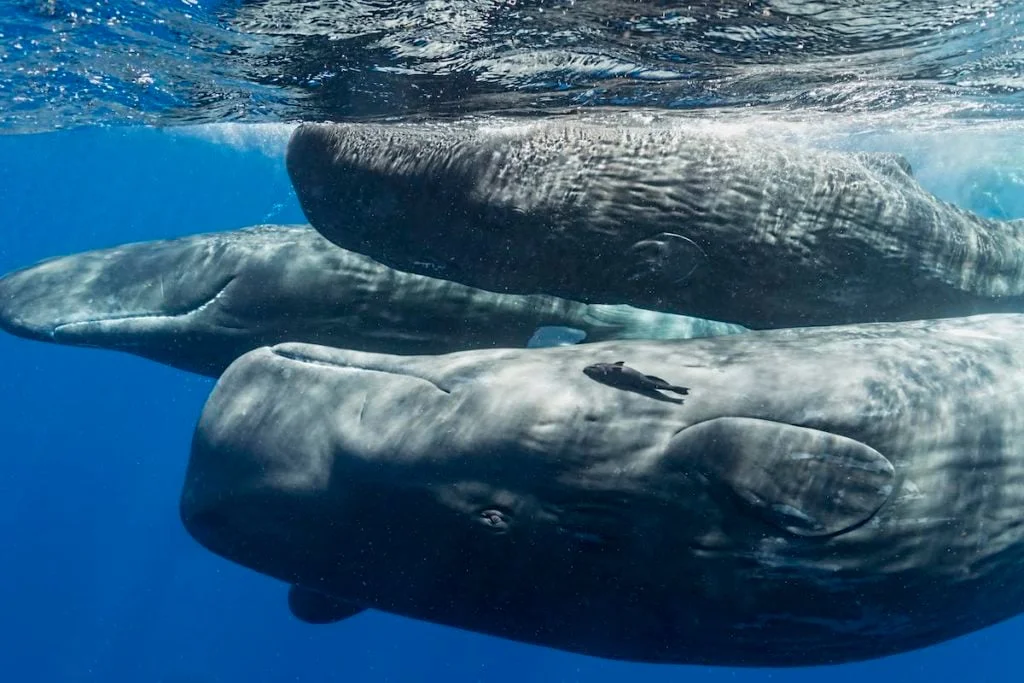
Among more than 70 known toothed whale species, the sperm whale is the only one described as anatomically capable of swallowing a person whole. It can grow up to 60 feet long, and its esophagus can stretch around large prey. Sperm whales hunt giant squid, which can exceed 20 feet in body length before their appendages are counted. That flexibility makes the fictional premise physically conceivable in a narrow sense.
But a possible fit is only one part of the question. Sperm whales spend much of their time in deep open water, including underwater canyons, and can dive to nearly 10,000 feet while searching for food. That habitat makes a chance encounter with a person uncommon in the first place. A person would also have to be in the right place at the right time, and the whale would have to swallow them rather than reject them.
Shane Gero, a whale biologist with Project CETI, told Popular Science that swallowing a person is not necessarily impossible, but would likely require the “biggest sperm whale ever.” Even then, the water rushing into the whale’s mouth or an attempt to expel the person could cause fatal injury before digestion began. So the narrow anatomical possibility doesn’t translate into a realistic survival story.
What the record shows—and what it doesn’t
There is no documented case of a whale swallowing a person. A report from the University of Cincinnati identifies the reticulated python as the only animal known to have swallowed a person whole. The available record therefore offers no real-life whale episode comparable to the one imagined in Whalefall.
That doesn’t make close encounters harmless. Being caught briefly in a whale’s mouth could still be frightening and physically dangerous, even when the whale cannot swallow a person. The distinction is between entering a mouth and passing through the throat into the digestive system—two events that can look similar in a dramatic retelling but are anatomically very different.
The larger risks run the other way
People have little reason to fear being swallowed by a sperm whale. These marine mammals face more familiar hazards in the ocean: vessel strikes, underwater noise and entanglement in fishing gear that has been lost or discarded. Research and conservation groups describe this discarded gear as “ghost gear,” and its risks are discussed by Ocean Conservancy and its ghost gear initiative. A separate account examines noise pollution as another pressure on whales. Information about sperm whales and their conservation status is also available from NOAA Fisheries.
For readers drawn to the film’s survival premise, the practical takeaway is clear: a baleen whale cannot swallow a person, and a sperm whale’s anatomy offers only a remote theoretical possibility. The more grounded story is how these large animals navigate an ocean filled with human activity—and how reducing hazards such as discarded fishing gear can make those waters safer for them.
More on the original subject is available from Ocean Conservancy.