Xpanner X1 Piling R6 Automates Solar and Battery Site Foundations
Xpanner’s X1 Piling R6 combines automated pile installation with live project tracking, aiming to reduce crew demands at solar and battery sites.


Foundation work can set the pace for utility-scale solar and battery energy storage construction. Xpanner’s new X1 Piling R6 is designed to automate pile placement and driving in one machine cycle, with the company aiming to reduce the crew and surveying work needed at each installation site.
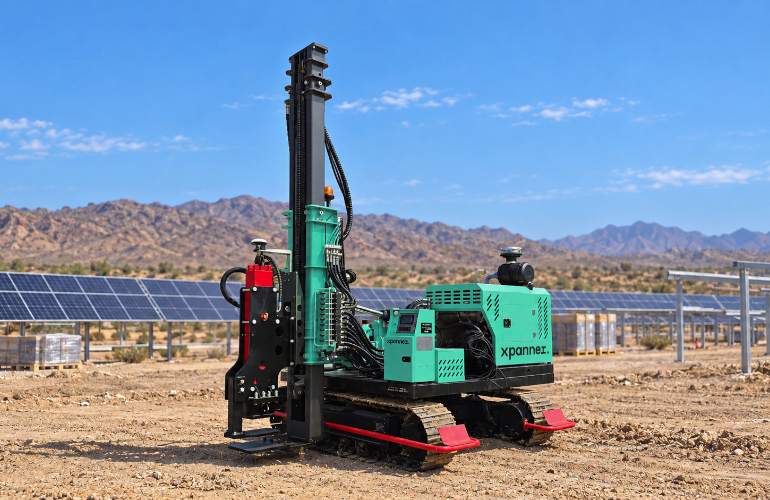
The system combines Xpanner’s automation technology with the Everstar R6 crawler base machine. An operator uploads the pile plan, positions the machine at a row and starts the sequence with one button. The X1 then moves between pile locations, aligns the hammer, drives each pile and checks that it remains plumb. The operator supervises with a remote controller rather than standing beside the mast.
Automating positioning and installation
Conventional pile installation often combines a two-person driving crew with separate surveying, marking and preparation. X1 is intended to bring those tasks into a coordinated workflow. High-precision GNSS antennas and receivers, other sensors and Xpanner’s automation controller guide the machine to planned pile locations and elevations. The system handles positioning and driving while one operator monitors its progress.
That arrangement could help construction teams manage crew constraints and repetitive foundation work as they build solar arrays and battery sites. It also changes where workers need to be during operation: Xpanner says no one needs to stand next to the mast. The source does not provide comparative safety data, so the practical effect will depend on how the equipment is operated and how each site organizes its work.
The company says X1 carries over the automation stack used on its PD10 platform, which has been deployed at more than 67 U.S. jobsites and used by more than 10 of the country’s largest engineering, procurement and construction firms. On the R6 base, Xpanner reports a 45% faster cycle time than the prior generation. That figure is the company’s comparison; actual output will also depend on ground conditions, pile specifications and the flow of work around the machine.
Power, reach and pile flexibility
The R6 has a 97 kW (130 hp) engine and a high-frequency hydraulic hammer with up to 1,260 joules (929 ft-lb) of impact energy. Operators can select among three energy settings to suit soil conditions. This gives the machine options for different ground resistance, though the source does not specify the soil types or testing behind those settings.
Positioning adjustments are built into the machine. Its guide rail travels 11.8 inches (300 mm) forward and backward and 19.7 inches (500 mm) side to side. The upper body rotates through 180 degrees, allowing the hammer to reach a target from one setup. These movements are intended to reduce repositioning between piles, a potential time saver where layouts require frequent small corrections.
X1 can handle piles up to 23 feet (7 metres) long and drive them to a maximum depth of 15.7 feet (4.8 metres). Because the hammer lowers close to the ground and piles can be driven flush with grade, Xpanner says a single machine can install standard tracker piles, shorter motor piles and battery-site foundation piles without an adapter. Those capabilities may simplify equipment planning across projects that use different foundation designs.
The machine is configured for field work with a large fuel tank, engine auto-idle, a high-capacity cooler, manual override and an emergency stop. Its mast does not need to be disassembled for transport. A multifunction mast could later support down-the-hole drilling, auger drilling and ground screwing on the same carrier, but Xpanner describes those as potential future capabilities. The company also says screw driving and pre-drilling are planned additions, rather than functions available at launch.
Project records and launch timing
Xpanner Connect, the company’s web-based project dashboard, links installation data to the work plan. Teams can upload pile schedules and coordinates, assign machines and configure a site. During operation, X1 records each pile’s position, depth and plumb, then sends the information to a live project map. Project managers can also view machine status, cycle counts and alerts across a fleet remotely.
That digital record could replace manual pile counts, phone updates, spreadsheets and end-of-shift summaries with a shared view of progress. For project teams, the value depends on accurate plans and reliable field data: the dashboard reports what the machine records, while managers still need to review whether installation matches project requirements.
Xpanner co-founder and CEO Henri Lee said demand to build power capacity for the grid and AI data centers is increasing pressure on construction crews. He described X1 as a way for one operator to drive piles, keep workers away from the mast and log each installation. The product’s central promise is therefore a combination of labor savings, more consistent positioning and immediate records of foundation work.
Commercial launch is scheduled for Oct. 26, 2026, through a Xpanner subscription. One agreement covers the machine, automation kit, Xpanner Connect and the company’s on-site support, which includes demonstration, site validation, training, operation and maintenance. During validation, Xpanner reviews the customer’s pile schedule to check reveal heights and embedment. For builders assessing the system, those checks and performance on actual site conditions will help show whether automation can translate into faster, well-documented foundation work.